
Introduction: Is Running a Small YouTube Channel Actually Worth It?
Many people wonder the same thing before starting a channel:
Can a small professional YouTube channel really make money?
You see big creators earning millions, but what about smaller channels with a few thousand subscribers?
The truth is simple.
Thousands of creators start channels every week, but most quit before they ever earn anything. Not because money is impossible… but because they don’t understand how YouTube income actually works or how long it takes.
This guide is written for:
- Content creators
- Freelancers
- Coaches and educators
- Small business owners
- Anyone building a professional niche YouTube channel
- Especially channels with fewer than 100,000 subscribers.
By the end of this article, you will clearly understand:
- How much small channels really earn
- Where the money actually comes from
- What affects your income the most
- How to increase your earnings faster
Quick Answer: How Much Does a Small YouTube Channel Make?
A small professional YouTube channel with 1,000–50,000 subscribers usually earns:
$70 to $3,000 per month.
The exact amount depends on:
- The niche
- The number of views
- Watch time
- CPM rates
- Monetization methods
However, income can grow much higher if you combine several income streams like:
- AdSense
- Sponsorships
- Affiliate marketing
- Digital products
- Services
In fact, some creators in high-paying niches earn $5,000+ per month with only 20,000 subscribers.
The key difference is professional strategy.
A professional channel with:
- consistent uploads
- strong audience retention
- clear monetization systems
can earn 5–10 times more than a casual channel of the same size.
What Determines How Much a Small YouTube Channel Earns?
Before looking at real numbers, you need to understand the five main factors that control YouTube income.
These factors explain why some small channels earn $50 per month, while others earn $3,000+.
1. CPM: The Biggest Factor
CPM means Cost Per Mille, or the amount advertisers pay per 1,000 ad impressions.
Different niches have very different CPM rates.
For example:
- Gaming: $2 – $4 CPM
- Lifestyle: $3 – $6 CPM
- Personal finance: $15 – $40 CPM
So two channels with the same number of views can earn very different money.
High-CPM YouTube Niches
Some niches consistently pay more:
- Finance and investing: $15–$40 CPM
- Software and tech tutorials: $12–$30 CPM
- Business and entrepreneurship: $10–$25 CPM
- Health and wellness: $8–$20 CPM
- Legal, insurance, real estate: $10–$35 CPM
- Education and online learning: $8–$18 CPM
2. RPM: The Number That Actually Matters
Many beginners misunderstand CPM.
What actually matters is RPM (Revenue Per Mille).
RPM shows how much you actually receive after YouTube takes its cut.
YouTube keeps about 45% of ad revenue.
Creators receive about 55%.
Example:
CPM = $10
Your RPM ≈ $5.50
So if your videos get 50,000 views per month, you might earn:
About $275 from ads.
That’s AdSense only, without any other monetization.
3. Watch Time and Audience Retention
YouTube’s algorithm strongly rewards videos that keep people watching.
Higher retention means:
- more recommendations
- more impressions
- more views
- more revenue
Another important rule:
Mid-roll ads only appear on videos longer than 8 minutes.
That’s why professional channels often publish 10–20 minute deep-dive videos.
These videos earn much more per view than short clips.
4. Posting Consistency
Channels that upload 1–3 videos per week usually grow faster.
There are two reasons:
- More videos = more total views
- The YouTube algorithm favors consistent creators
Professional channels usually use:
- a content calendar
- batch recording
- scheduled uploads
This system gives them a big advantage over creators who upload randomly.
5. Passive vs Active Monetization
Many beginners rely only on ads.
That’s passive monetization.
You only earn when someone watches ads.
Professional creators build active monetization systems, such as:
- sponsorships
- affiliate links
- digital products
- memberships
The most successful small channels use both.
From studying hundreds of creator income reports, one mistake appears again and again:
Small channels wait too long to diversify income.
You don’t need 100k subscribers to start monetizing.
You can start at 1,000 subscribers or even earlier.
Real Income Breakdown by Channel Size
| Channel Size | Monthly Views | AdSense Earnings | Sponsorships | Total Estimated Monthly Income |
|---|---|---|---|---|
| Nano (0–1K subs) | 500–5,000 | $1–$20 | $0–$50 | $1–$70 |
| Micro (1K–10K subs) | 5,000–50,000 | $20–$200 | $50–$300 | $70–$500 |
| Small Pro (10K–50K subs) | 50,000–250,000 | $200–$1,000 | $300–$2,000 | $500–$3,000 |
| Mid-Tier (50K–100K subs) | 250,000–500,000 | $1,000–$2,000 | $2,000–$5,000 | $3,000–$7,000 |
| Growing Pro (100K–500K subs) | 500,000–2,000,000 | $2,000–$8,000 | $5,000–$20,000 | $7,000–$28,000 |
Here are realistic monthly earnings for small professional channels.
Nano Channels (0–1,000 subscribers)
At this stage you cannot join the YouTube Partner Program yet.
Requirements:
- 1,000 subscribers
- 4,000 watch hours
But you can still earn through affiliate marketing.
Example:
- Amazon links
- software tools
- courses
Typical income
$0 – $70 per month
Micro Channels (1k – 10k subscribers)
Once you join the YouTube Partner Program, ads start generating revenue.
Typical monthly income:
- AdSense: $20 – $200
- Affiliate marketing: $50 – $300
- Small sponsorships: $50 – $200
- Total range: $70 – $500 per month
Small Professional Channels (10k – 50k subscribers)
This is where income starts becoming meaningful.
You now have enough social proof for:
- brand deals
- stronger affiliate sales
- product launches
Typical monthly breakdown:
- AdSense: $200 – $1,000
- Sponsorships: $300 – $2,000
- Affiliate marketing: $200 – $800
- Digital products: $100 – $1,500
- Total: $500 – $3,000+ per month
Best Monetization Strategies for Small Channels
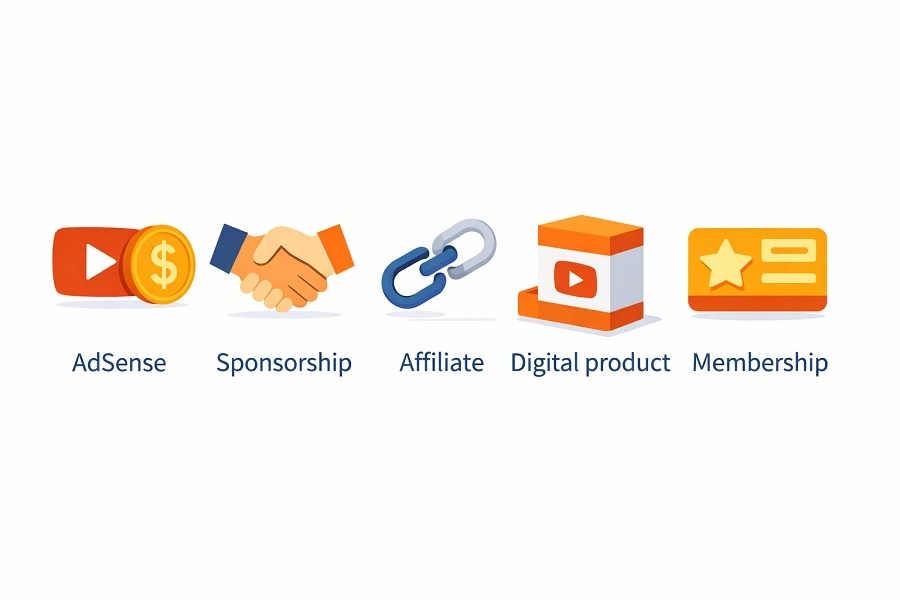
The highest-earning creators rarely depend on one income stream.
- They combine several.
1. AdSense
AdSense is the foundation.
It is passive and stable.
But relying on it alone is risky.
Focus on improving CPM by targeting high-value niches and professional audiences.
2. Brand Sponsorships
Sponsorships can dramatically increase revenue.
Even small channels can charge:
- $500 – $2,000 per sponsored integration
Brands care more about audience relevance and engagement than subscriber count.
Platforms that connect creators with brands include:
- Grapevine
- AspireIQ
- Creator.co
3. Affiliate Marketing
Affiliate marketing is one of the most underrated income streams.
You recommend tools you already use.
If viewers buy using your link, you earn a commission.
Popular programs:
- Amazon Associates
- ShareASale
- Impact
- SaaS affiliate programs
Some software tools pay 20–40% recurring commissions.
4. Digital Products
If your channel teaches a skill, digital products are extremely powerful.
Examples:
- templates
- ebooks
- toolkits
- mini courses
Even a small audience can generate strong revenue.
Example:
5,000 subscribers
2% buy rate
$47 product
That launch alone could generate $4,700.
5. Channel Memberships
YouTube memberships start at 500 subscribers.
You can offer:
- exclusive content
- Q&A sessions
- community access
- early videos
Example:
100 members
$4.99 per month
That equals $499 recurring monthly income.
How Long Does It Take to Make Real Money?
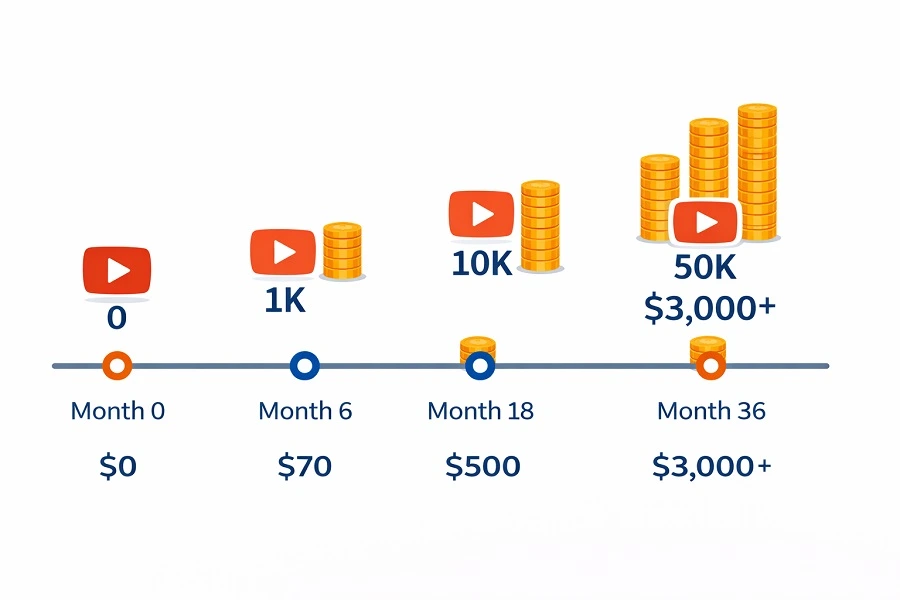
Let’s be honest.
Most channels don’t earn meaningful income immediately.
Here is a realistic timeline.
- Month 1–3
- Focus on learning and improving content
- Income: $0
- Month 3–6
- First affiliate clicks
- Income: $10–$50
- Month 6–12
- Approaching 1,000 subscribers
- Income: $50–$200
- Month 12–18
- AdSense + first sponsorships
- Income: $200–$800
- Month 18–24
- 10k subscribers
- Income: $800–$3,000
- Month 24–36
- Established monetization systems
- Income: $3,000 – $10,000+
This assumes publishing 1–2 quality videos per week.
How to Maximize Your YouTube Income
If you want to grow faster, focus on these actions.
- Target high-CPM keywords.
- Make 10–20 minute videos to allow mid-roll ads.
- Start building an email list immediately.
- Email subscribers convert much better than YouTube viewers.
- Pitch brands yourself instead of waiting.
- Analyze YouTube analytics monthly.
- Double down on videos that perform best.
- Always include clear calls-to-action.
- Batch record videos to stay consistent.
- Collaborate with channels of similar size.
Conclusion: Small Channels Can Make Real Money
A small professional YouTube channel can realistically earn:
$500 – $3,000 per month with 10k–50k subscribers.
And often much more if the creator builds:
- sponsorships
- affiliate income
- digital products
The most important lesson is this:
Subscriber count is not the main driver of income.
Your earnings depend much more on:
- niche
- audience quality
- monetization strategy
A 20k-subscriber finance channel can easily earn more than a 200k entertainment channel.
Treat your channel like a business from the beginning, and the income potential becomes very real.
FAQ
How many views are needed to earn $1,000 per month?
With an average RPM of $5, you need about 200,000 monthly views from ads alone.
However, combining sponsorships and affiliate marketing can reach $1,000 with only 30k–50k views.
Can a channel with 1,000 subscribers make money?
Yes.
Once you reach 1,000 subscribers and 4,000 watch hours, you can join the YouTube Partner Program.
You can also earn from affiliate marketing even earlier.
What niche pays the most on YouTube?
Highest-paying niches include:
- Finance
- Software/SaaS
- Legal and insurance
- Business education
- Real estate
These niches often have CPM rates above $15.
How much does YouTube pay per 1,000 views?
Average RPM is around:
- $3 – $5 per 1,000 views
- But premium niches can earn $8 – $20 RPM.
Is it too late to start a YouTube channel?
No.
YouTube remains the second largest search engine in the world.
Professional niche channels still have huge opportunities.